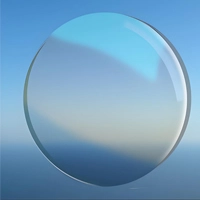
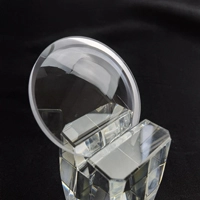
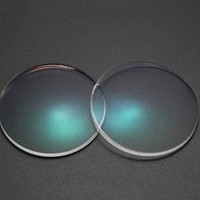
Freeform progressive lens manufacturing combines computer-generated surface design with digitally controlled RX surfacing. Instead of relying only on a fixed progressive curve molded into a semi-finished blank, the laboratory calculates a surface for the prescription, frame and fitting parameters. The result can be optimized for distance, intermediate and near vision, but its performance still depends on accurate measurements, suitable corridor selection and production control.
A freeform progressive lens is a power-variation spectacle lens whose continuously changing optical surface is calculated digitally and produced through computer-controlled surfacing for a prescription and fitting configuration.
How Digital Surfacing Changes Progressive Lens Manufacturing
A conventional progressive lens commonly starts with a molded progressive surface and receives the remaining prescription on the opposite side. Freeform production moves more design work into software. The laboratory calculates a point-by-point surface, generates it with computer numerically controlled equipment, then polishes and verifies the lens.
A technical review describes freeform surfacing as three-axis processing in X, Y and Z using machinery, design software and a progressive-lens calculation. It reports that a complex progressive surface can be generated in approximately 60 seconds, although total laboratory time also includes blocking, polishing, coating and inspection. A typical workflow includes:
importing the prescription, monocular PD, fitting height, frame and position-of-wear data;
calculating the progressive surface, prism thinning and compensated powers;
generating, polishing, coating, marking and verifying the finished lenses.
Digital surfacing is a manufacturing method, not proof that every freeform design performs identically. Software determines how power progression and unavoidable lateral astigmatism are distributed, while production accuracy determines whether the calculated design reaches the wearer.
| Comparison point | Conventional progressive lens | Freeform progressive lens |
| Progressive geometry | Limited family of molded designs | Digitally calculated for the selected order |
| Prescription surfacing | Usually spherical or toroidal | Point-by-point generated surface |
| Wear-position inputs | Often based on assumptions | Can include measured vertex distance, tilt and wrap |
| Corridor and inset | Fixed design options | Adjustable within the design system |
| Main production risk | Blank, decentration or fitting error | Data, calculation or surfacing error |
| Best use | Standardized ranges | Flexible and personalized RX programs |
Corridor Design, Inset and Unwanted Astigmatism
The corridor connects the distance zone at the top of the lens with the near zone below it. A shorter corridor can suit shallow frames and reduce downward eye movement, but it compresses the power change into less vertical space. A longer corridor spreads the progression over more distance, although the near zone sits lower.
Progressive surfaces inevitably develop unwanted astigmatism beside the corridor. The design task is not to eliminate it completely, but to control its magnitude, position and rate of change. The cited review notes that progressive power can be placed on the front, back or both surfaces, giving designers different ways to distribute aberrations.
Corridor selection should consider:
available fitting height after the frame is adjusted;
addition power and the balance among distance, intermediate and near zones;
working distance, posture and frequency of screen or close work;
monocular inset based on convergence rather than a generic assumption.
The review notes that conventional designs often assume an inset of about 2.5 mm per lens, while actual convergence varies. This is why monocular near-position calculations can matter in customized freeform multifocal lenses.
RX Customization and Position-of-Wear Compensation
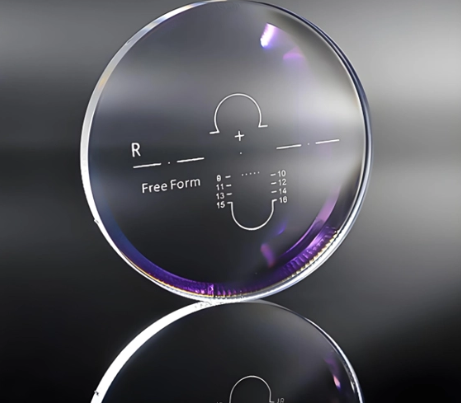
Personalization begins with the prescription but should not end there. Modern calculation systems may use vertex distance, pantoscopic tilt and frame wrap to trace rays through the lens in its worn position. These inputs can affect compensated sphere, cylinder, axis, prism and the distribution of usable viewing areas.
The RX laboratory should receive:
right and left monocular PD and individual fitting heights;
frame dimensions, shape and minimum edge-thickness requirements;
vertex distance, pantoscopic tilt and wrap angle when required;
corridor preference, coating, tint and special prism instructions;
the intended balance between distance, screen and near tasks.
For a standard-material program, a 1.56 progressive lens may combine the progressive prescription with photochromic or coating options. The order should still separate design, substrate and treatment specifications so that any performance issue can be traced correctly.
Verification and Laboratory Communication
Finished PALs need verification against both lens specifications and the prescription order. ISO 8980-2:2017 covers optical and geometrical requirements and verification methods for uncut finished power-variation lenses. ISO 21987:2017 covers mounted spectacle lenses relative to the prescription order and was confirmed as current in 2023, although a revision project is under development.
Verification should confirm distance and near reference powers, prism reference point, markings, fitting height, monocular centration, orientation and cosmetic quality. A randomized double-masked crossover trial involving 95 experienced PAL wearers shows why evaluation should extend beyond central acuity: researchers assessed distance and near vision, 30-degree off-axis acuity and the horizontal extent of clear reading vision.
Crystal Optical’s RX freeform range lists indexes from 1.49 through 1.74 and diameters from 50 to 80 mm, enabling the laboratory to match design, prescription and frame requirements. Buyers may also compare bifocal lens and progressive lens options or add functions such as photochromic prescription lenses when required.
 Lenses.png "Photochromic (Transition) Lenses.png")
Conclusion
Freeform manufacturing gives an RX laboratory greater control over progressive geometry, corridor placement, inset and position-of-wear compensation. It does not remove unavoidable peripheral aberrations or correct inaccurate fitting automatically. Reliable results come from a compatible design, complete order data, controlled digital surfacing and verification against optical standards.
FAQ
Is digital surfacing the same as a freeform lens design?
No. Digital surfacing is the production method; the freeform design is the mathematical surface calculated by software.
Can freeform progressive lenses eliminate peripheral distortion?
No. Design optimization can redistribute and manage unwanted astigmatism, but it cannot remove it entirely.
How is progressive corridor length selected?
It depends on fitting height, frame depth, addition power, working distance and the desired balance among viewing zones.
Why are monocular PD measurements important?
They position each lens relative to its eye and help avoid right-left centration errors.
Which position-of-wear measurements may be required?
Depending on the design, the laboratory may need vertex distance, pantoscopic tilt and frame wrap.
What should buyers provide for RX customization?
Provide the prescription, fitting data, frame details, material, corridor choice, coating and any special-use priorities.

 English
  日本語
日本語  한국어
한국어  français
  Deutsch
  Español
  italiano
  русский
  português
  日本語
日本語