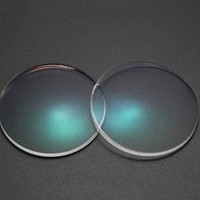
Bifocal Lens vs Progressive Lens: How to Decide What’s Best
Presbyopia – The reason for Bifocal/Progressive Lenses
Presbyopia is a term that many people are unfamiliar with yet it is rather common, especially among the elderly. When the lens of the eye ages and loses its flexibility, presbyopia develops. The eye’s natural capacity to focus on things at various distances is eventually inhibited by this loss of pliability, resulting in blurriness and general difficulty seeing. This is what leads to many people being fitted with bifocal lenses and progressive lenses.
What are Bifocals?
Bifocal glasses are glasses that contain two different lens powers in one or both lenses. This is so the wearer can see well both up close and from distance. Bifocals can be in contacts as well which is known as multifocal. Bifocal/multifocal contact lenses are a great option for someone who can't see well up close but doesn’t want to wear glasses. You can even get sunglasses with bifocals & bifocal transition lenses!
Types of Bifocal Lenses
Bifocal lenses can come in several different types, which include:
Flat-top: On the side of a flat-top bifocal is a little piece shaped like a half moon or the letter “D.” It’s on the inside of the nose, near the bottom of the lens. A patient can pick between a 25 mm segment and a 28 mm segment, depending on their preferences. A noticeable line in the lens may be seen at the top of the segment.
Round Seg: A round bifocal is a lens with a 22 or 24 mm round section at the bottom. This bifocal was created to make it easier for the wearer to access the segment’s reading area. Round portions are no longer as popular as they once were.
Blended: Prior to the development of no-line bifocals, blended bifocals were common. They usually consist of a spherical section with edges that blend in with the rest of the lens. While it is plainly obvious to a skilled optician, it is significantly less visible to the rest of the world than a flat-top bifocal.
Executive: An executive bifocal is a line bifocal in which the top half (distance) and bottom half (near) of the lens are totally split by a visible lens that reaches all the way across the lens. These were popular with people who did a lot of office and desk work since they
What are Progressive lenses?
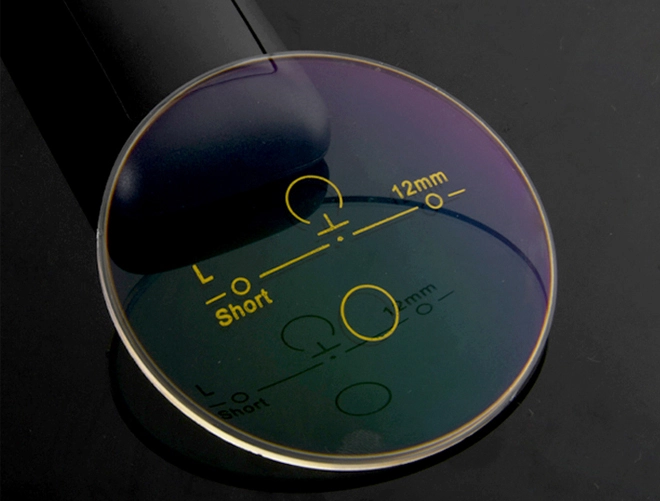
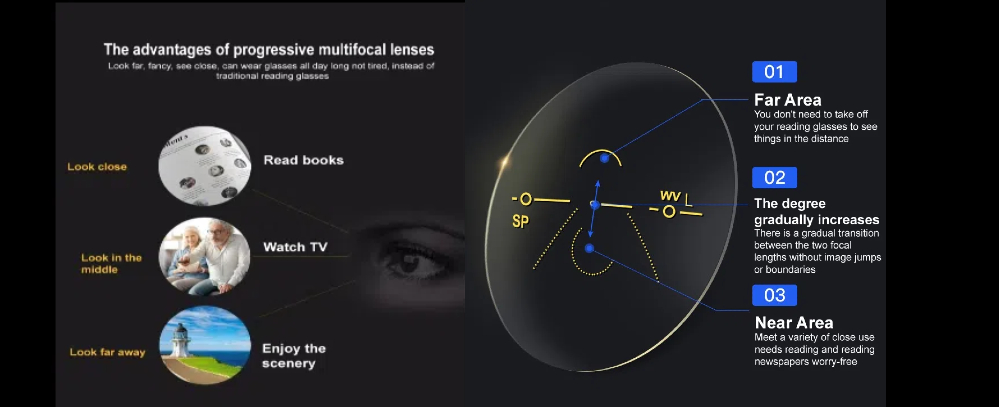
Progressive lenses are essentially “no line bifocals”. Instead of having a demarcated bifocal, the lens, such as a 1.56 progressive lens, will have power that gradually shift. This will allow the wearer to see at all distances. Progressive contact lenses are also an option for those who don’t want to wear glasses. There are no lens lines, and people won't notice a bifocal line in your glasses.
Getting Used to Progressive Lenses
It may take some time to get used to your progressive lenses. Right after switching, some progressive lens wearers may notice headaches, blurry vision, and difficulty balancing. This can be frustrating at first, but it is important for you to get used to your new lenses. Here are some techniques:
When reading, move the book, not your eyes or head.
Hold the item you are looking at about 18 inches away from you, and make sure you are looking through the bottom of your lenses.
If your lenses are still bothering you after a few weeks, talk to your eye doctor. A new prescription may be necessary.
Don’t switch between your new pair of glasses and your old one. It’s important to acclimate your eyes to the new lenses.
It is important to be patient when switching to progressive lenses. It can take anywhere from a few days to a few weeks to get used to them. However, they are a great option if you aren’t a fan of bifocals.
Bifocal Lens vs Progressive Lens: Key Differences
When comparing bifocal lens and progressive lens series, both are designed to correct presbyopia, but they differ in lens design, vision range, appearance, and user experience. Understanding these differences can help you choose the most suitable solution based on your prescription, daily activities, and budget.
Feature
Bifocal Lens
Progressive Lens
Vision Correction
Near & Distance
Near, Intermediate & Distance
Visible Line
Yes
No
Intermediate Vision
Not Available
Smooth Intermediate Vision
Adaptation Period
Short
Several Days to Weeks
Appearance
Visible Segment Line
Seamless, Natural Appearance
Cost
More Affordable
Higher
Overall, the biggest difference between bifocal lens and progressive lens is how they provide vision correction. Bifocal lenses offer two fixed viewing zones for near and distance vision, while progressive lenses provide a gradual transition across multiple focal distances without visible lines, creating a more natural visual experience.
Pros and Cons of Bifocal Lenses
Pros
Easy to adapt to, especially for first-time multifocal lens wearers.
More affordable than progressive lenses.
Provides a wider near-vision reading area.
Ideal for users who mainly switch between reading and distance vision.
Cons
Visible dividing line may affect the appearance of the glasses.
Does not provide intermediate vision for computer work.
Some wearers may experience image jump when shifting between viewing areas.
Pros and Cons of Progressive Lenses
Pros
Seamless vision correction for near, intermediate, and distance viewing.
No visible lens line, providing a more modern appearance.
Better suited for computer work, driving, and everyday activities.
Eliminates the image jump commonly associated with bifocal lenses.
Cons
Generally more expensive than bifocal lenses.
Requires an adaptation period for many first-time wearers.
Some users may notice slight peripheral distortion during the adjustment period.
What's the Right Lens For Me?
Presbyopia is treated with progressive and bifocal lenses, which give pleasant vision for people who have several prescriptions. Within the lens, progressive lenses easily change between near and far prescriptions. In bifocal lenses, however, a distinct line separates near and far vision. When deciding which sort of optical lens is appropriate for you, think about your lifestyle and personal preferences.
Crystal Optical - Your Trusted Prescription Eyeglass Lenses Supplier
As a specialized optical lens company in China, Crystal Optical specializes in high-quality bifocal and progressive lenses designed to deliver seamless vision correction for presbyopia. With 15+ years of expertise, our lenses combine advanced technology and precision engineering to offer:
Superior Optical Performance: Available in multiple indices (1.499 to 1.67), including lightweight polycarbonate (1.59 PC) and durable CR-39, with options like HMC, AR coating, and Super Hydrophobic treatments for enhanced durability and clarity.
Customized Solutions: Tailored designs such as flat-top bifocal, multifocal progressive, and photochromic lenses to suit diverse lifestyle needs, including specialized options for children’s myopia management.
Innovative R&D: Backed by a team of postgraduate engineers and patented technologies, we ensure cutting-edge lens molds (aspheric/progressive) and consistent quality.
High-Capacity Production: State-of-the-art facilities produce 2.78 million lenses annually, guaranteeing competitive pricing without compromising on precision or delivery timelines.
Trusted by global partners, including Essilor, we empower clear, comfortable vision at all distances. Elevate your eyewear offerings with Crystal Optical’s reliable, innovative bifocal and progressive lenses today!
Frequently Asked Questions
Are progressive lenses better than bifocals?
Progressive lenses provide seamless vision at multiple distances, while bifocals offer two distinct viewing zones. The better option depends on your daily activities and visual needs.
Which lenses are better for computer work?
Progressive lenses generally perform better because they include an intermediate vision zone designed for computer screens.
How long does it take to adjust to progressive lenses?
Most users adapt within a few days to two weeks, although some may need longer depending on their prescription and previous eyewear experience.
Are bifocal lenses cheaper than progressive lenses?
Yes. Bifocal lenses are generally more affordable because they have a simpler lens design.
Can progressive lenses replace bifocals?
In many cases, yes. Progressive lenses provide near, intermediate, and distance vision in one lens without visible lines.

 English
  日本語
日本語  한국어
한국어  français
  Deutsch
  Español
  italiano
  русский
  português
  日本語
日本語