Suitable Groups for Progressive Lens
-
Middle-aged and elderly : the adjustment ability of the eyes of the elderly gradually decreases, due to the weakening of the elasticity of the lens, the adjustment ability of the eyes decreases, resulting in difficulties in reading or seeing things at close range. Progressive lenses can easily cope with the many needs of seeing far, fancy and close.
-
Multiple ametropia : people who not only have presbyopia, but also nearsightedness or farsightedness, progressive lenses can seamlessly transition to meet vision needs at different distances.
-
Office worker : people who work on computers for a long time, but need to check files frequently and switch between near and far, progressive lenses can help them see objects at different distances better.
-
Young people : young people with nearsightedness or farsightedness and adjustment dysfunction, progressive lenses can correct refractive errors on the basis of auxiliary adjustment, help them see objects at different distances better.
Specification of 1.56 Blue Cut Progressive Multifocal Vision Lenses for Far and near Vision Lenses
Index | 1.523 |
Material | NK55 UV420 |
Diameter | 65/70 mm |
Power Range | SPH -8.00~ +6.00 CYL: 0~ -6.00 |
Abbe Value | 38 |
coating | UC / HC / HMC / SHMC |
Coating clour | Colour Clear |
Design | Progressive |
Advantages of 1.56 Blue Cut Progressive Multifocal Vision Lenses For Far And Near Vision Lenses

Relieves eye fatigue : Progressive lens design can reduce the strain on the eyes for long periods of close work, by providing a smooth transition of different focal lengths, help to reduce eye swelling and fatigue .
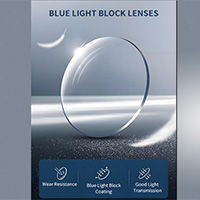
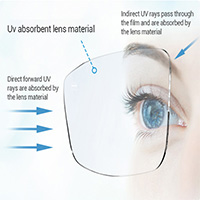
Protect your eyes from blue light : Anti-blue lenses filter out some blue light, reducing irritation and damage to your eyes.
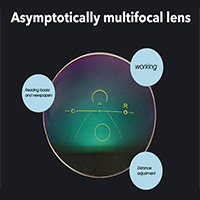
Provide a multi-focal visual experience : progressive lenses combine the functions of farsighted and nearsighted lenses, avoiding the hassle of frequently changing different glasses . The wearer can see distant objects through the top of the lens and close objects through the bottom of the lens, achieving natural transition and versatility.